Basics first.
Before going deeper into feeding schedules, pH, flour, temperature, or lievito madre, I think we need a clearer shared language. If we are going to keep talking about baking in any serious way, it helps if we mean the same thing when we use the same words.
One of the things social media has made very obvious to me is how much confusion there is around sourdough terms. People use one word for several different things, then answer from hidden assumptions. Part of that came from my own baking. Part of it came from watching what people keep posting, asking, sharing, and arguing about online. The deeper I went into stiff builds and lievito madre work, the less useful one loose word, starter, became.
In the beginning that did not bother me much. There was the jar. There was the dough. There were the usual questions. How often should I feed it? Should it live in the fridge? How stiff should it be? What pH should I look for? But at some point the subject stopped behaving like one simple jar story. Liquid starter maintenance, a temporary levain for a bake, a firmer branch, and a more serious lievito madre system were not the same thing anymore. They were connected, but they were not interchangeable.
That is really all this article is trying to do. I am not trying to settle every feeding ratio or every pH target here. I just want the words to be clearer first, so the later questions do not rest on confusion from the start.
I also do not think there is one perfect global source of truth for all of this language. A lot of baking terminology is regional, school-based, and passed on through practice more than through one official standard. That is exactly why I think a shared working language matters.
The same thing matters even when you are alone in your own kitchen. If you are trying to think your own process through more clearly, or trying to make your baking more specific and repeatable, then the language has to hold. You need to know what is for what, what belongs to maintenance and what belongs to a build, what belongs to ordinary starter work and what belongs to lievito madre work. If that is blurry even in your own head, it becomes very easy to do the wrong thing in the wrong place and then not understand why the result drifted.
Start With Starter
When I say starter in this article, I mean a maintained flour-and-water culture that you keep alive over time. In the beginning it is just flour and water, not yet a real starter. It becomes a real starter only after that mixture establishes itself as a stable living culture you can actually keep going. That does not happen immediately, and it does not happen by flour and water alone as if time did not matter. It depends on feeding, routine, temperature, and whether the culture settles into a readable pattern instead of just bubbling for a while. Its job is not to be a one-off recipe ingredient. Its job is to be the source culture from which later decisions can be made.
A starter can enter your kitchen in different ways. You can build one from scratch. You can get some from another baker. You can start from a dried culture. That origin story may matter in the beginning, but after a while the more important thing is role. Once it becomes the culture you keep, feed, observe, and maintain over time, it is functioning as your starter.
A starter also needs feeding because it is a maintained culture. I do not need to get into exact ratios yet to say that much. The important thing here is simpler than ratios. A starter is something you keep going.
That is also one of the biggest practical differences compared with commercial yeast. A starter asks for time, attention, and a bit of continuity. You are not just opening a packet when it suits you. You are trying to keep something alive, readable, and stable without pushing it too far in the wrong direction. That can be one of the most rewarding parts of sourdough, but it can also be the part that makes you stop at some point and think: why am I doing all this at all.
This is also where the first useful boundary appears. A starter is not automatically a levain. It is not automatically a build. It is not automatically lievito madre. And it is not automatically every old recipe that happens to use the words sourdough starter.
That last point matters more than it sounds. I recently came across an old sourdough bread starter recipe that begins with dry yeast, sugar, and potato flakes. That may still be a workable old-school kitchen system for a certain result, but it is clearly not the same object I mean here. The name alone is not enough.
In Most Online Sourdough Talk, Starter Usually Means Liquid Starter
This is one of the hidden defaults that causes a lot of later confusion.
In a huge amount of home sourdough language, when people simply say starter, they are really talking about a looser flour-and-water culture, usually something close to liquid and often maintained around equal flour and water by weight. I am not turning that into a law of the universe. I am just naming the default picture that sits behind the word in a lot of online baking talk.
That hidden default matters because it travels silently. Someone asks about a firmer build. Someone else asks about lievito madre. A third person answers from the logic of an everyday liquid jar starter without saying that clearly enough. At that point the confusion has already started before anyone has even argued about fermentation, temperature, or flavor.
This is one of the biggest reasons I wanted liquid starter named explicitly before getting to lievito madre. A lot of advice online is not wrong because liquid starters are wrong. It is wrong because the speaker assumes a liquid starter while the listener is already asking about something else.
Mother Starter Is Fine If The Role Is Clear
I do not think mother starter is a bad phrase. It is normal online baking language, and in many cases it works well enough. If someone says keep your mother starter stable and build separately for the bake, I usually understand what they mean.
The phrase becomes weak only when people expect it to carry more precision than it really does.
I have seen mother starter used for the maintained culture, for the jar in general, and sometimes for almost anything that feels like the original source. That is why I no longer care much about whether the term sounds elegant. I care whether the role is clear. Are we talking about the maintained source culture from which later builds are taken? If yes, then the sentence is already much easier to trust.
So when I hear mother starter, I read it as informal language for the main maintained source culture. That is close enough for me, as long as the role is not muddy.
Levain Or Build Comes From That Source Culture
This is the next distinction that really matters.
A levain, or build, is how I will talk in this series about a temporary portion taken from the maintained culture and prepared for a specific purpose. You take some of the source culture, feed it or shape it according to the needs of a specific bake, and then use it. Its job is not to be your whole long-term maintenance system. Its job is to become ready for dough.
I am not saying that every baker in every country uses the word this way. They do not. In French baking language, for example, levain can also refer more broadly to the culture itself. And online the word gets used even more loosely. Someone starts flour and water from zero and calls it levain. Someone keeps a culture in the fridge and calls the whole jar levain. Someone feeds a maintained culture and labels the whole action a levain refresh. That looseness is exactly why later advice starts drifting.
If the line between maintained culture and temporary build is blurry, then the rest of the advice becomes blurry with it. A timing target that makes perfect sense for a temporary bake-day build may be badly misplaced when someone applies it to a culture that is just living in maintenance mode.
That is why I want to keep the sequence in this series simple:
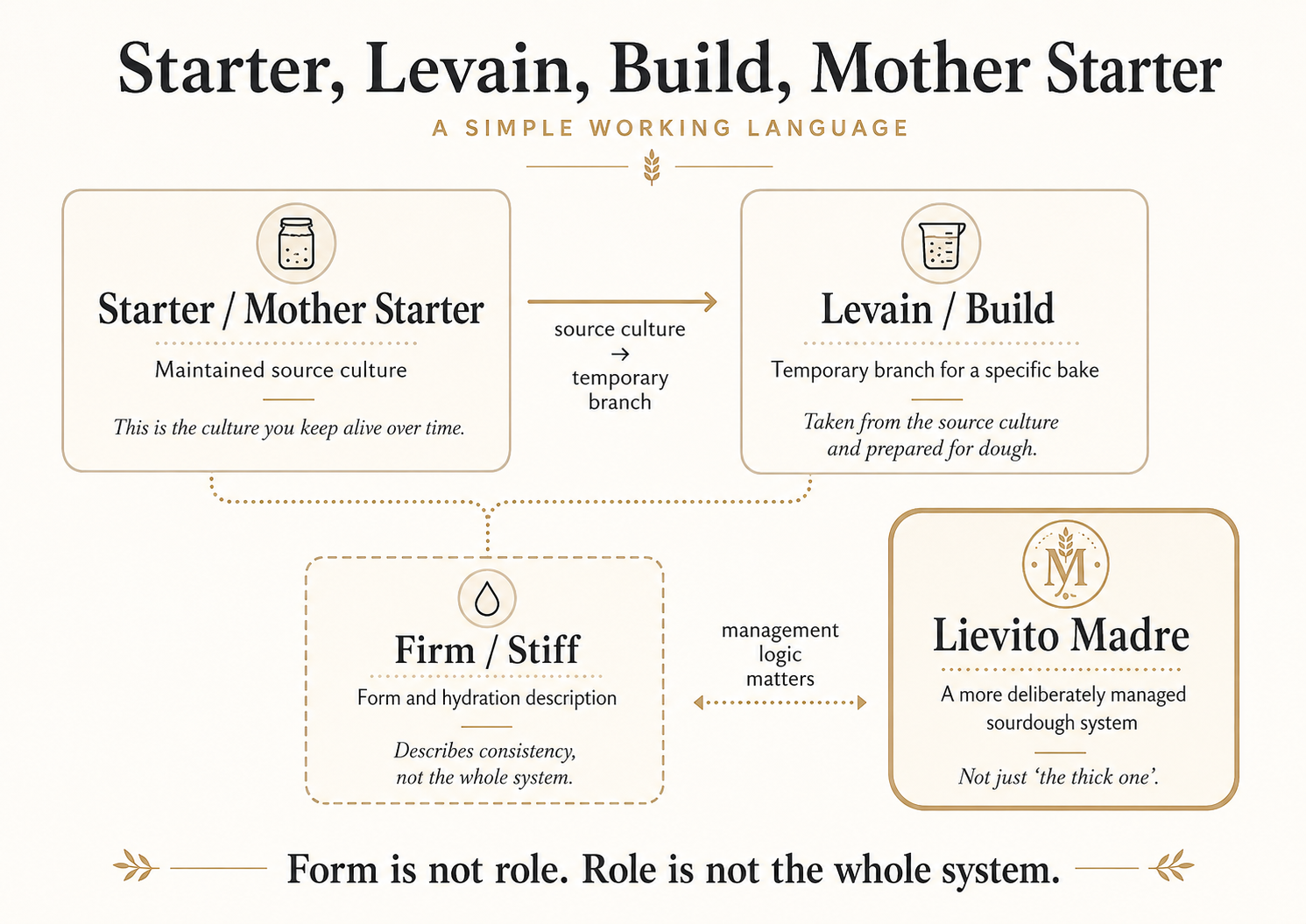
starterormother starteris the maintained source culturelevainorbuildis a temporary branch that comes from it
I am not offering that as the only acceptable definition in the world. I am choosing it because it keeps the later conversation clearer.
Firm And Stiff Describe Form First
I already touched the hydration side of this in the first article, so I do not want to repeat that whole argument here.
The only part that matters for this post is simpler. Firm and stiff are form words first. They tell you something about consistency, handling, and hydration. They do not automatically tell you whether you are looking at a maintained culture, a temporary build, or a full lievito madre system.
That is the practical mistake I keep seeing. Someone hears stiff starter and starts imagining the whole rest of the process from that one phrase. But the phrase may still be pointing to very different things:
- a firmer maintained starter
- a temporary low-hydration build
- one branch inside a lievito madre workflow
Those are not the same object, even if they may look similar in the hand. That is the only point I care about here. Form is not yet role. And role is still not the whole system.
Lievito Madre Is Not Just The Thick One
Lievito madre is Italian. Literally, it points toward mother leaven or mother culture. But in practice I do not use it as a fancy synonym for starter. I use it when the culture is being managed inside a more specific system.
That is the real difference.
When I say lievito madre, I do not mean only that the culture contains less water. I mean that the culture is being managed with clearer phase separation, narrower working targets, and often more deliberate production logic.
The most useful way I found to understand that was to stop treating LM as one continuous blob and break it into phases:
| PHASE | WHAT IT ACTUALLY IS |
|---|---|
| construction | building or converting the culture into the LM line |
| maintenance | the ongoing base routine that keeps the culture stable |
| activation | the tighter pre-use refresh sequence that pushes the culture into a specific working window |
| application | the point where the culture goes into dough for the actual product |
These phases are not unique to lievito madre. You can see the same broad logic in liquid starter work too. The difference is that lievito madre systems make those boundaries matter much more in practice. Maintenance stops being the same thing as activation. Production prep stops being the same thing as just keeping the culture alive.
The second useful correction is form. The more I looked into Italian practice and professional lievito madre systems, the clearer it became that this world does not contain only one form. You can see liquid, semisolid, and solid versions inside it. That matters because it breaks the lazy assumption that lievito madre simply means 50% hydration and nothing else.
This is the simplest way I can put it:
liquid starteris a looser maintained starter formfirmandstiffdescribe form and handlinglievito madredescribes a more deliberately managed system, which may itself include liquid, semisolid, or solid forms
That does not mean liquid starter and LM belong to different biological universes. They do not. They still live in the same broad sourdough world. What changes is the selection pressure created by hydration, feeding structure, temperature, physical handling, and target product. That can shift the balance of the culture, the acid profile, and the way the culture behaves. In practice that is also why people often describe LM bakes as cleaner or less sharply sour. The point is not that magic bacteria appear. The point is that the system is steering the culture differently.
This is also where some very concrete LM practices start making sense. If you have watched enough panettone professionals online, you have probably seen some of them already. You see repeated pre-use refreshes. You see semisolid or solid forms. You also see bakers, especially in Italian panettone and grandi lievitati work, keeping the culture tied, wrapped, or held in water. You see it untied, unwrapped, and judged by the tension it is holding. That is not the usual language of a generic liquid starter jar. It is the language of a culture being physically managed toward a narrower production target.
That is why I no longer hear lievito madre as just the thick one. The thickness may be part of the picture, but the real difference is the system.
Why This Order Matters
If this ladder is blurred, the later advice starts wobbling immediately.
If starter silently means liquid starter, then advice travels where it should not. If mother starter and levain are blurred together, maintenance and build language get mixed. If firm and stiff are treated like full systems, people start smuggling lievito madre assumptions into places where they do not belong. And if lievito madre is reduced to hydration alone, then the most important part, the management logic, disappears.
This is not just word-policing. It is practical.
A feeding ratio can be right for one object and wrong for another. A pH claim can sound precise while actually belonging to a build rather than a maintained culture. A cold-storage recommendation can fail because it was written for one system and copied into another. Even an expectation about flavor can miss the mark if the culture behind the sentence was never clearly named in the first place.
The same problem shows up very quickly in real work too. Put people from different kitchens, schools, or countries in the same room and the risk is not only that they disagree. The risk is that they think they agree because the same words are being used, while the actual things behind those words are different. That matters in training, in production, and even in ordinary conversations where one person is trying to help another.
I could see that in my own notes too. I keep a notebook around all of this, and these days AI helps me manage parts of it across my cooking, baking, experiments, and all the random things I end up testing. I do not treat AI as something to trust blindly, but it does make some things easier to organize, compare, and revisit. Looking back through my own tests and research, it became obvious that some of my earlier assumptions were too simple. I gave pH too much authority before I was even clear enough about what culture and what phase I was looking at, and I treated some lievito madre questions too much like liquid starter maintenance questions. My own research did not magically remove that confusion, but it did widen the picture. It helped me see more clearly what different people were doing, what different systems were trying to achieve, and where I needed to separate things more carefully.
That is all I wanted this article to do.
Before we keep going deeper, I want the language to stay this simple:
starter= the maintained source cultureliquid starter= the looser starter form that online sourdough language often assumes by defaultmother starter= acceptable informal language for that maintained source culturelevainorbuild= a temporary branch built from that source culture for a specific bakefirmandstiff= form descriptions, not full systemslievito madre= a more deliberately managed sourdough system, not just a thicker starter
Once that much is clear, the next questions finally become worth answering properly.